Yes — e-cigarettes can genuinely help you quit smoking, and in 2026 the evidence supporting them is stronger than it has ever been. For older adults who have tried patches, gum, and sheer willpower without lasting success, e-cigarettes offer something fundamentally different: they tackle both the nicotine craving and the deeply ingrained physical ritual of smoking. It is that combination — not nicotine replacement alone — that makes them work where other methods have failed.
The Short Answer: Do E-Cigarettes Actually Help You Quit?
The honest answer is yes — for many people, especially those who have smoked for decades. But there are things worth understanding before you rush out and buy one. Here is the version your doctor would give you if they had a little more time in the consultation room.
- Around 14% of adults over 65 in the UK are still regular smokers — and most have tried and failed to quit using traditional methods at least once.
- Pooled clinical data shows e-cigarettes are roughly 1.6 to 1.8 times more effective than nicotine patches or gum when used consistently over at least 12 weeks.
- For long-term smokers, the hardest part of quitting is not just the nicotine — it is the ritual of smoking. E-cigarettes address this in a way patches and gum simply cannot.
- In 2026, UK-regulated e-cigarettes are simpler to use, more affordable, and subject to tighter quality controls than devices from even five years ago, making them a realistic option for older adults.
Why Is Quitting So Hard After Decades of Smoking?
If you have been smoking for 20 or 30 years, you already know the shape of this problem. Quitting is not simply a matter of weaning yourself off nicotine — although that is certainly part of it. It is about unpicking a behaviour that has become woven into the fabric of your day. The morning cigarette with a cup of tea. The one after dinner. The natural pause that punctuates a long afternoon. These moments are not about nicotine alone. They are about identity, rhythm, and comfort.
Research into smoking behaviour consistently shows that long-term smokers face a dual dependency. The first is physical: nicotine creates genuine chemical changes in the brain that generate intense cravings and uncomfortable withdrawal symptoms. The second is behavioural: the hand-to-mouth action, the act of inhaling, the pause before exhaling — these become powerful triggers entirely on their own. Studies suggest that this behavioural dependency accounts for up to 40% of relapse cases. A treatment that addresses only the nicotine is missing a very large part of the problem.
For older adults, there is an added layer of complexity. Many long-term smokers have developed associated health conditions — reduced lung capacity, cardiovascular changes, or chronic joint pain — that make vigorous exercise difficult. This removes one of the key distraction strategies that younger quitters rely on. NHS smoking cessation data confirms that adults over 60 who have smoked for more than 30 years have significantly lower unaided quit rates than younger smokers. The longer the habit, the more important it is to choose the right tool.

What Exactly Is an E-Cigarette and How Does It Work?
An e-cigarette — also called a vape or e-cig — is a battery-powered device that heats a liquid into a vapour that you inhale. The liquid, known as e-liquid or vape juice, typically contains nicotine, propylene glycol, vegetable glycerine, and flavourings. Crucially, it does not contain tobacco, and there is no combustion involved. That means no tar and no carbon monoxide — two of the most harmful components of cigarette smoke.
Modern e-cigarettes come in several styles. Pen-style devices are slim and simple — similar in shape and feel to a cigarette. Pod devices are compact, often pre-filled, and require no setup. Refillable tank systems give you more control but involve topping up with e-liquid yourself. For older adults who want simplicity, disposable e-cigarettes or pre-filled pod devices are usually the easiest starting point. They require nothing except taking them out of the packaging and drawing on them.
The device works through a small heating element called an atomiser. When you draw on the mouthpiece, the atomiser heats a tiny amount of e-liquid in its cartridge or tank and turns it into the vapour you inhale. This delivers nicotine to your bloodstream quickly — mimicking the sensation of a real cigarette more closely than any other nicotine replacement product currently available. It is this combination of nicotine delivery plus the physical sensation of inhaling and exhaling that makes e-cigarettes a genuinely different proposition from a patch on your arm.
— Dr Susan Cartwright, Respiratory Physician and Smoking Cessation Specialist
How Do E-Cigarettes Help You Stop Smoking?
The key to understanding why e-cigarettes work lies in that dual dependency. When you switch from cigarettes to an e-cigarette, you are not going cold turkey on either front. You still get nicotine. You still have something to hold and put to your lips. You still inhale and exhale. What changes is what you are inhaling — and in health terms, that change is enormous. No tar, no combustion gases, no carbon monoxide.
The typical approach is to use an e-cigarette to get completely off cigarettes first, without trying to cut down on nicotine at the same time. Then, over weeks or months, you gradually reduce the nicotine level in your e-liquid. Most e-liquids come in strengths ranging from 0mg up to 20mg per millilitre. As you step down, many people find themselves comfortable on very low-nicotine e-liquid, at which point stopping vaping altogether becomes a much smaller and more manageable step than quitting cigarettes was.
What Nicotine Strength Should You Start With?
The single most common mistake first-time e-cigarette users make is choosing a nicotine level that is too low. If you smoke regularly and start on weak e-liquid, you will feel unsatisfied, reach for a cigarette, and conclude that e-cigs do not work. They do work — but only at the right strength. As a guide: if you smoke more than 15 cigarettes a day, start at 18–20mg/ml. For 10 to 15 a day, try 12–16mg/ml. Lighter smokers can often start at 6–12mg/ml. In 2026, UK regulations cap e-liquid nicotine at 20mg/ml, which is sufficient for most heavy smokers. Nicotine salt formulations, available in pod devices, deliver nicotine especially smoothly and feel particularly close to a real cigarette — worth trying if standard e-liquid feels harsh at higher strengths.
— Claire Hewson, NHS Stop Smoking Adviser
What Does the Evidence Say About E-Cigs in 2026?
The evidence base for e-cigarettes as a stop-smoking tool has grown considerably over the past several years. Cochrane systematic reviews — which pool data from multiple clinical trials — have consistently found that nicotine e-cigarettes are more effective for quitting than traditional nicotine replacement therapy. In head-to-head trials, approximately 18 in 100 people using e-cigarettes quit successfully, compared with around 10 in 100 using patches or gum. That gap translates to a meaningful difference in real-world outcomes.
When e-cigarettes are combined with behavioural support — such as an NHS Stop Smoking service, a counselling programme, or a structured quit plan — success rates improve further. A 2025 analysis of long-term e-cigarette use in older adults found that consistent users were significantly more likely to remain smoke-free at 12 months than those who alternated between e-cigs and cigarettes. The research is clear: consistency is the single biggest predictor of success. Using an e-cigarette occasionally while still smoking — known as dual use — is much less effective and is generally not recommended as a long-term approach.
Public Health England — now the UK Health Security Agency — famously concluded that vaping is approximately 95% less harmful than smoking cigarettes. That specific figure continues to be refined by ongoing research, but the broad scientific consensus in 2026 remains clear: switching from cigarettes to e-cigarettes represents a very substantial reduction in overall health risk, particularly for cardiovascular health and lung function. For older adults already managing health conditions, that difference is not academic — it is clinically significant.
— Professor Alan Marsh, Professor of Public Health and Tobacco Dependence Research
Are E-Cigarettes Safe for Older Adults?
This is the question most older adults — and their families — want answered honestly. The answer is nuanced. E-cigarettes are not risk-free. Nicotine itself has cardiovascular effects: it temporarily raises heart rate and blood pressure. For older adults with existing heart conditions or uncontrolled hypertension, this is a genuine consideration that is worth discussing with your GP before you start. The long-term effects of inhaling vapour are also still being studied, and researchers are appropriately cautious about making absolute claims.
However, the comparison that matters most is not “e-cigarettes versus nothing.” It is “e-cigarettes versus continuing to smoke cigarettes.” Cigarette smoke delivers carbon monoxide, tar, and more than 70 known carcinogens directly into your lungs with every puff. E-cigarette vapour contains none of these. For a current smoker, the evidence strongly supports the view that switching to e-cigarettes dramatically reduces overall health risk — even for older adults with pre-existing conditions.
For older adults managing chronic health conditions, quitting smoking is one of the most high-impact steps available. Smoking drives systemic inflammation throughout the body, which can significantly worsen chronic pain. If you are already exploring ways to manage conditions like fibromyalgia and chronic pain, quitting smoking deserves a place near the top of your list — the anti-inflammatory benefit of removing combustion from the equation is substantial and relatively quick to appear.
How Do E-Cigs Compare to Patches, Gum, and Other Methods?
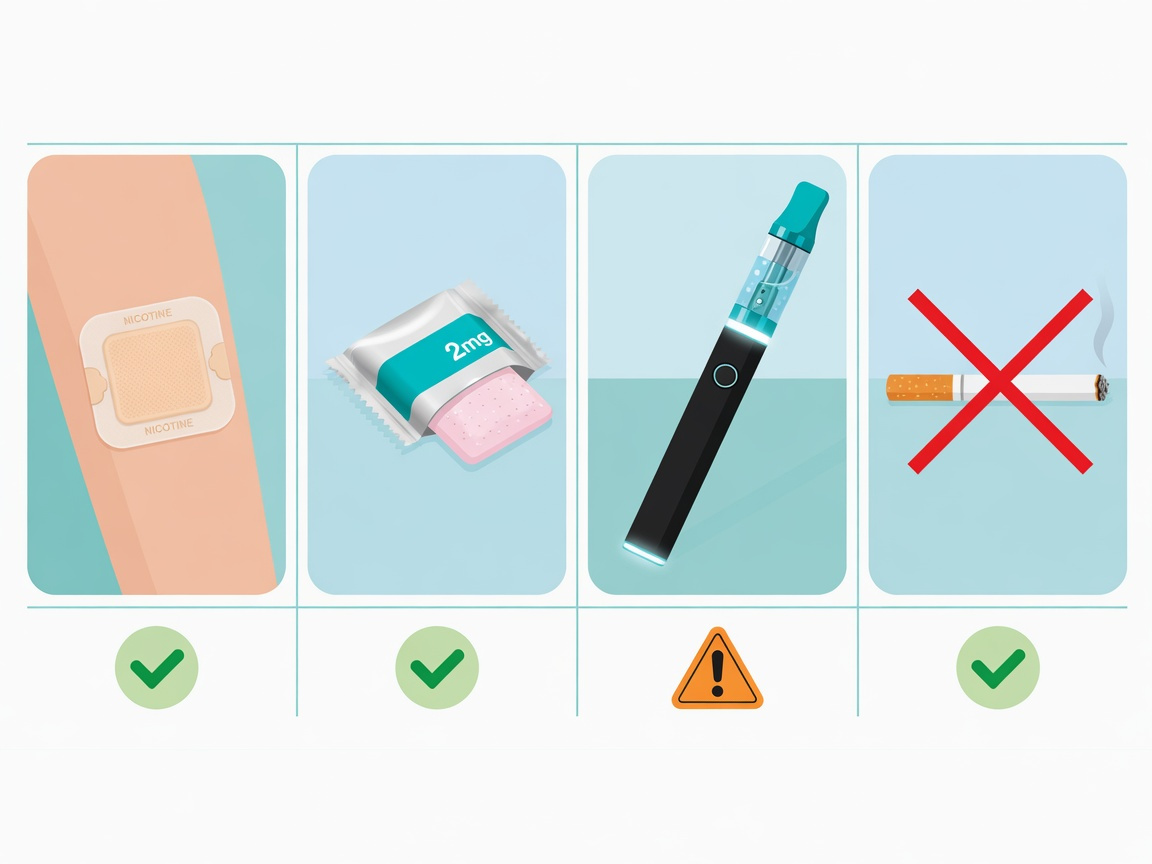
There is no shortage of ways to try to quit smoking. Nicotine patches, gum, nasal sprays, inhalers, prescription medications, and cold turkey are all approaches your doctor or a stop-smoking service might recommend. Each has its place. Here is how the main options compare on the factors that matter most to older adults who have been smoking for many years.
| Method | Addresses Nicotine? | Addresses the Ritual? | Approx. Success at 12 Months | Notes for Older Adults |
|---|---|---|---|---|
| Nicotine patches | ✅ Yes | ❌ No | ~10–12% | Simple to use; no hand-to-mouth action |
| Nicotine gum / lozenges | ✅ Yes | ❌ No | ~8–11% | May be awkward with dental problems |
| Nicotine inhaler | ✅ Yes | ⚠️ Partially | ~10–14% | Closer to smoking action; slower nicotine delivery |
| Varenicline (Champix) | ✅ Yes | ❌ No | ~22–25% | Requires prescription; check drug interactions carefully |
| E-Cigarettes | ✅ Yes | ✅ Yes | ~18–21% | No prescription needed; simple devices available |
| Cold turkey (unaided) | ❌ No support | ❌ No support | ~3–5% | Lowest success rate; not recommended for long-term smokers |
Varenicline, sold in the UK as Champix, actually shows slightly higher clinical trial success rates than e-cigarettes used alone. However, it requires a prescription and carries a significant list of potential side effects — including nausea, vivid dreams, and in some cases mood changes. It also interacts with a number of commonly prescribed medications. For older adults managing several health conditions, the simplicity and accessibility of e-cigarettes often makes them the more practical choice in practice.
The nicotine inhaler is worth a mention. It requires no prescription, provides a hand-to-mouth action closer to smoking than patches or gum, and has been available for years. However, most users find it less satisfying than e-cigarettes: it delivers nicotine more slowly, produces no visible vapour, and does not convincingly replicate the sensation of smoking. For long-term smokers, that sensory gap is often enough to undermine the attempt before it has really begun.
What Does a Real-Life Success Story Actually Look Like?
Margaret, 71, from Cheshire, had her first cigarette at 17 and smoked for over 50 years. She had tried nicotine patches three times, gum twice, and one course of Champix she abandoned after two weeks due to vivid nightmares and persistent nausea. “I had honestly given up on giving up,” she says. “I had just decided it was part of who I was.”
Her granddaughter encouraged her to try an e-cigarette in late 2024. Margaret was sceptical — she found the technology intimidating at first and fully expected it to feel nothing like smoking. Her GP recommended she begin with a simple disposable device at 20mg/ml nicotine to get a feel for it, rather than committing to a refillable kit straight away. Within two weeks, she was off cigarettes entirely. By month three, she had stepped down to 12mg/ml. By month six, she was on 6mg/ml and vaping only a handful of times a day.
By October 2025 — exactly one year after her last cigarette — Margaret was completely nicotine-free. At a routine check-up, her lung capacity had improved by around 12% from her pre-quit baseline. Her GP noted a measurable improvement in resting heart rate. Her blood pressure had come down enough to warrant a review of one of her regular medications. Most importantly to Margaret: she could walk to the local shops without stopping to catch her breath — something she had struggled with for several years.
“Everything is just easier,” she says simply. “I sleep better, I breathe better, I have more energy, and I am saving a fortune.” She and her husband now walk every morning, attend a weekly dance class, and recently booked their first holiday abroad in years. It is a reminder that when health improves, so does everything else — and there is plenty of evidence that retirement can be genuinely energetic and fun once the physical barriers start to lift.
What Is the Best Step-by-Step Plan for Quitting With E-Cigarettes?
A clear, realistic plan significantly increases your chances of success. Here is a practical six-step approach designed specifically for older adults — one that does not expect an overnight transformation, and does not punish you for taking it slowly.
This six-step process takes time — and that is by design. For older adults who have smoked for decades, patience and consistency matter far more than speed. Research consistently shows that people who stick with e-cigarettes beyond the first month — rather than switching back and forth — achieve the best long-term outcomes. A difficult week in month one is not a sign of failure. It is simply part of a process that takes months, not days.
How Much Will E-Cigarettes Cost You?
Cost is a real and fair concern — particularly for older adults on a fixed income. The good news is that e-cigarettes are substantially cheaper than a cigarette habit over any timeframe, once you look past the upfront cost of a starter kit.
In 2026, a basic pen-style or pod starter kit costs between £15 and £40 from a UK retailer or pharmacy. Monthly e-liquid costs for a moderate vaper run to around £15–£25. That puts annual e-cigarette spending at roughly £200–£340 for most regular users. Compare this with a 20-a-day cigarette habit in the UK, which now costs over £4,500 per year at current prices. The average smoker who switches to e-cigarettes saves in excess of £4,000 every single year — a saving that compounds with every year they stay smoke-free.
For those who want to try vaping before committing to a device, disposable e-cigarettes are available from around £3–£5 each — an affordable test run. For regular use, a refillable pod device with bottled e-liquid is far more economical over time. Switching away from cigarettes is among the most cost-effective health decisions available. If you are already thinking carefully about managing healthcare costs in later life, it is worth reading about whether genuinely affordable healthcare is achievable — because quitting smoking ranks among the highest-impact, lowest-cost interventions there is.
What Should You Discuss With Your Doctor Before Starting?
E-cigarettes do not require a prescription, and for most healthy adults the decision to switch is relatively straightforward. But if you are managing several health conditions, a short conversation with your GP before you start is well worth the appointment. It takes less than five minutes and could save you considerable uncertainty later.
Key things to mention: any cardiovascular conditions, current medications, kidney or liver concerns, and whether you are on blood thinners or anticoagulants. Nicotine temporarily raises heart rate and blood pressure — significant if you have heart disease or uncontrolled hypertension. Quitting smoking also changes how your body metabolises certain medications, including some antidepressants, insulin, and blood pressure drugs. This is almost always a beneficial change, but your prescriber may want to monitor you and review dosages as your system adjusts.
Your GP can also refer you to your local NHS Stop Smoking Service, which provides specialist support at no cost and has access to a range of resources well beyond what a GP can offer in a routine appointment. In 2026, many NHS stop-smoking services actively recommend e-cigarettes as a cessation tool. Some areas even offer subsidised starter kits or vouchers for patients ready to make a quit attempt — it is always worth asking whether such a scheme is available near you.
— Dr Priya Anand, General Practitioner and Public Health Advocate
Frequently Asked Questions About E-Cigarettes and Quitting Smoking
Are e-cigarettes safe for older people with breathing problems?
For older adults with COPD, asthma, or reduced lung function, e-cigarettes are widely considered far safer than continuing to smoke. Cigarette tar and combustion gases — not nicotine — are the primary drivers of lung damage in smokers. E-cigarettes produce neither. Some people experience mild airway irritation when they first start vaping; if this happens, try a lower-powered device or a higher-VG (vegetable glycerine) e-liquid, which tends to be smoother. Always speak with your respiratory specialist before switching if you have severe or unstable lung disease.
Do I need a prescription to buy an e-cigarette in the UK?
No. In the UK, e-cigarettes and e-liquids are available over the counter at pharmacies, supermarkets, and specialist vape retailers — no prescription required. In 2026, regulated devices sold by UK-based retailers must meet safety standards set by the Medicines and Healthcare products Regulatory Agency (MHRA). Always buy from reputable UK suppliers rather than unregulated overseas sources, where product quality and ingredient transparency cannot be guaranteed.
How quickly will I feel the health benefits after switching from cigarettes?
Some improvements arrive remarkably quickly. Within 48 hours of your last cigarette, carbon monoxide levels in your blood return to normal, and your senses of smell and taste typically begin to recover. Within a month, most ex-smokers notice better breathing and more day-to-day energy. Over months and years, cardiovascular risk drops substantially and lung function continues to improve — even in older adults who have smoked for decades. The body’s capacity for recovery at any age is genuinely remarkable.
Can I use e-cigarettes if I take medication for heart disease?
This depends on your specific medications and condition, and you should ask your GP or cardiologist directly. Nicotine — from any source — can temporarily raise heart rate and blood pressure. However, for most patients, the cardiovascular benefit of stopping combustion cigarettes far outweighs the residual risk from nicotine in an e-cigarette. Your doctor may want to monitor your blood pressure more closely in the first few weeks of switching, which is straightforward to arrange.
Is it better to quit smoking completely, or is switching to e-cigs enough?
The long-term ideal is to become completely nicotine-free. But for older adults who have smoked for decades, switching to e-cigarettes first and then gradually reducing the nicotine level is a far more realistic and achievable path than attempting immediate cold turkey. Research consistently shows that a staged, harm-reduction approach — getting off cigarettes now, even if still using e-cigs — delivers significant health gains. Becoming fully nicotine-free is a worthy goal; it is simply the second step, not a prerequisite for starting.
I tried e-cigarettes before and they did not work. Should I try again?
Yes — and the reason they did not work is almost certainly the nicotine level. The most common cause of a failed first attempt is using an e-liquid that is too weak, or a device that delivers nicotine too slowly to feel satisfying. Device technology and e-liquid formulations have improved significantly since earlier generations of vaping products. If your previous attempt felt unsatisfying or left you reaching for cigarettes within hours, try again with 18–20mg/ml for heavier smokers, and consider nicotine salt e-liquids, which many people find particularly close to the feel of a real cigarette.
What are the best e-cigarette options for older adults in 2026?
For older adults who want simplicity, the best starting point is usually a pre-filled pod device or a disposable e-cigarette from a reputable UK brand — nothing to fill, configure, or adjust. Once you are comfortable with vaping, a simple refillable pod kit gives better value and lets you control your nicotine level precisely. Look for devices sold through UK pharmacies or regulated UK retailers, which guarantees the product meets current MHRA safety standards. Avoid cheap, unbranded devices from unregulated overseas marketplaces.
If you have been putting off making the switch, 2026 is an excellent time to try. Devices are simpler and better made than at any previous point. E-liquids are more tightly regulated. NHS support for using vaping as a cessation tool is stronger than it has ever been. The evidence is firmly on your side, and your body’s ability to begin recovering the moment you stop smoking is on your side too. The only thing left is taking the first step — and that part is entirely in your hands.
Start this week. Buy a starter device from a UK pharmacy or vape retailer. Tell your GP you are making a quit attempt. Call your local NHS Stop Smoking service. Each of those actions takes about five minutes. The return on that investment could be years of better breathing, more energy, and thousands of pounds in your pocket every year from here on.