Falls are the leading cause of injury-related death among adults over 65, and one in four older adults falls at least once every year. Balance exercises are one of the most powerful things senior citizens can do to change those numbers — strengthening stabilising muscles, sharpening coordination, and helping older adults stay active, independent, and confident for longer.
Key Takeaways
- Falls are the #1 cause of injury-related death among adults aged 65 and older — and targeted balance training directly reduces that risk.
- Regular balance exercises can lower fall risk by up to 40%, with evidence-based programmes showing even greater results in community-dwelling seniors.
- Balance naturally declines with age due to muscle loss, vision changes, and inner ear deterioration — but this decline is not inevitable with the right training.
- A simple 10–15 minute daily routine produces measurable improvements in stability, confidence, and mobility within just 4–8 weeks.
What Are Balance Exercises for Seniors?
Balance exercises are movements specifically designed to improve your body’s ability to maintain a stable position — whether you are standing still, shifting your weight, or moving through your environment. They range from simple static movements like standing on one leg to dynamic activities such as tai chi, walking drills, and targeted leg and core strengthening. For senior citizens, they form a cornerstone of healthy, active ageing.
Unlike strength training, which focuses primarily on building raw muscle power, balance training specifically targets the neuromuscular system — the communication network between your brain, nerves, and muscles. When this system is well-trained, your body makes rapid, automatic adjustments to keep you upright even when you stumble on uneven pavement or reach unexpectedly beyond your centre of gravity.
A key concept in balance rehabilitation is proprioception — your body’s awareness of its own position in space. Research in geriatric medicine shows this sense declines significantly after age 60, and that targeted balance training helps retrain it. Studies published in physical therapy journals find measurable improvements in standing stability typically appear within six weeks of consistent practice. According to physiotherapists specialising in falls prevention, even two to three sessions per week is sufficient to deliver meaningful results for most older adults.

Why Does Balance Decline as We Age?
Balance is not controlled by a single system — it is the product of three working in tandem: the muscles and joints, the inner ear (vestibular system), and vision. As we age, all three tend to become less efficient, and the cumulative effect on stability can be substantial.
Muscle loss (sarcopenia) is one of the biggest contributors. After age 40, the body loses roughly 1% of muscle mass per year in people who are not actively working to maintain it. By age 70, many older adults have lost between 25% and 40% of the muscle mass they had at midlife. Weaker leg and core muscles mean less physical support for the joints and spine — making it harder to hold steady when balance is challenged.
Inner ear changes affect the vestibular system, which controls your sense of movement and spatial orientation. Age-related deterioration here is common and can produce subtle but persistent feelings of unsteadiness. Meanwhile, changes in vision reduce the quality of environmental information the brain uses to maintain upright posture. Finally, slower nerve conduction means reflexes take longer to fire — so when a stumble begins, the body’s corrective response arrives late. The encouraging news is that balance training compensates for these changes by refining and strengthening the systems that remain highly responsive to exercise.
How Serious Is the Fall Risk for Senior Citizens?
The statistics here are stark and important to understand. According to the CDC, falls are the number one cause of injury-related death among adults aged 65 and older in the United States. They result in more than 3 million emergency room visits every year. Approximately 800,000 older adults are hospitalised annually because of fall injuries — most commonly for head trauma or hip fractures.
Adults aged 65 and older fall at least once per year, according to the CDC. Many go unreported due to fear or embarrassment — meaning the true figure is likely even higher.
Hip fractures are among the most devastating consequences. Research from the NIH shows approximately 95% of hip fractures result from falls — usually a sideways fall onto the hip. Recovery is slow and difficult, and according to NIH data, up to 30% of older adults who sustain a hip fracture do not return to their pre-fracture level of independence. The annual medical cost of falls among older adults in the United States exceeds $50 billion, according to CDC estimates — a figure projected to grow significantly as the population ages through 2026 and beyond.
The annual medical cost of falls among older adults in the United States, per CDC estimates — making fall prevention one of the highest-value health interventions available.
There is also a significant psychological dimension. Many older adults who fall — or who fear falling — begin restricting their movements and activities. This self-imposed limitation leads to further muscle loss and social isolation, which paradoxically increases future fall risk. It can become a downward spiral. Balance training is one of the most effective interventions known to break that cycle.
What Are the Top Benefits of Balance Exercises for Senior Citizens?
The benefits of regular balance training go well beyond fall prevention. Here is what research and clinical practice consistently show for older adults who commit to a routine:
- Reduced fall risk. Structured balance programmes reduce fall risk by 20–40% in older adults. The evidence-based Otago Exercise Programme consistently demonstrates fall reductions of 35% or more in community-dwelling seniors aged 65 and older.
- Greater muscle strength. Many balance exercises simultaneously strengthen the legs, hips, and core — the muscles most responsible for stability in daily movement.
- Better coordination and faster reaction time. Balance training sharpens the neuromuscular system, helping the body respond more quickly when a trip or slip begins.
- Increased confidence and less fear of falling. Older adults who train regularly report feeling significantly more secure when moving around their homes and in public — and this encourages more physical activity, not less.
- Improved daily functioning. Better balance makes climbing stairs, getting in and out of chairs, walking on uneven ground, and a wide range of household tasks noticeably easier.
- Reduced joint pain. Strengthening the muscles surrounding the knees and hips can ease chronic joint discomfort — a secondary benefit regularly reported by seniors in balance training programmes.
Which Balance Exercises Work Best for Senior Citizens?
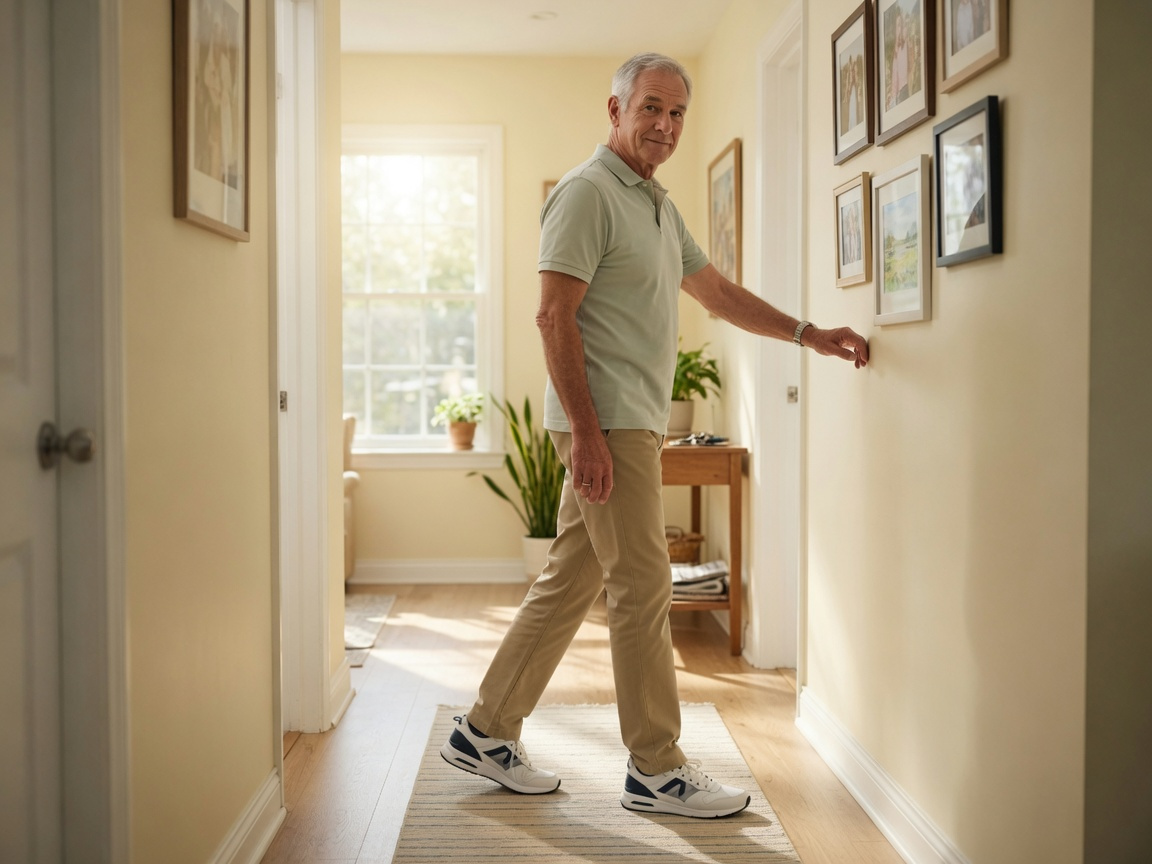
The best balance exercises for seniors are safe, effective, and easy to fit into a daily routine. Always keep a sturdy chair, countertop, or wall within reach when you first begin — especially in the early weeks. Here are six proven exercises to build your programme around.
How Can Seniors Start a Balance Routine Safely?
Starting safely is just as important as starting at all. The goal in the first few weeks is to build confidence and form consistent habits — not to push to maximum effort. Here is a practical step-by-step framework for senior citizens beginning a balance programme in 2026.
- Get medical clearance first. Talk to your GP before starting any new exercise routine — especially if you have osteoporosis, Parkinson’s disease, peripheral neuropathy, or a history of falls. Your doctor may refer you to a physiotherapist who can design a programme matched to your ability level and health status.
- Prepare your exercise space. Clear the area of rugs, electrical cords, and clutter. Ensure the lighting is good. Have a sturdy chair, wall, or countertop within arm’s reach throughout every session — and use it freely.
- Wear supportive footwear. Non-slip, well-fitting shoes with good ankle support reduce the risk of slipping during exercises. Avoid training in socks or bare feet on smooth floors until your balance is well established.
- Start with just 10 minutes daily. Short, consistent sessions outperform long, infrequent ones. A 10-minute daily routine delivers better results than a 45-minute session twice a week. Consistency is everything.
- Keep a phone within reach. Always have a mobile phone nearby when exercising alone. A senior-friendly smartphone with a large screen, simplified navigation, and accessible emergency features is ideal for having close at hand during solo exercise sessions.
- Progress gradually. Only increase the challenge of your exercises once you can complete the current level with confidence. Patience here is not a weakness — it is a strategy.
| Exercise | Difficulty | Equipment Needed | Primary Benefit | Daily Time |
|---|---|---|---|---|
| Single-Leg Stand | Beginner | Chair or wall | Proprioception & core stability | 2–3 min |
| Heel-to-Toe Walk | Beginner | Wall (optional) | Gait coordination | 5 min |
| Tandem Stand | Beginner | None | Deep core balance | 3 min |
| Side Leg Raise | Beginner | Chair | Hip abductor strength | 5 min |
| Sit-to-Stand | Beginner–Intermediate | Sturdy chair | Leg strength & functional movement | 3–5 min |
| Tai Chi (beginner class) | Intermediate | Open space | Full-body balance, coordination & mindfulness | 20–30 min |
What Does Recent Research Say About Balance Training in 2026?
The evidence base for senior balance training has continued to strengthen through 2025 and into 2026. Research published in geriatric medicine and physical therapy journals consistently confirms that targeted balance training delivers measurable, lasting improvements in fall prevention, mobility, and quality of life for older adults.
Studies examining the Otago Exercise Programme — a well-studied set of individually tailored balance and strengthening exercises delivered by a physiotherapist — have shown fall reductions of 35% or more in community-dwelling seniors aged 65 and older, with benefits maintained across 12-month follow-up periods. The research on tai chi is equally compelling: multiple meta-analyses of randomised controlled trials find regular practice reduces fall incidence by 40–47%, placing it among the most effective single-modality balance interventions in the literature. Research published in 2025 examining virtual reality-based balance rehabilitation found VR-assisted programmes produced results comparable to in-clinic physiotherapy for mobile, community-dwelling seniors — a significant finding for those with limited access to in-person care.
📋 Case Study: Margaret’s 8-Week Balance Journey
Background: Margaret, 72, a retired teacher from the Midwest, came close to a serious fall while reaching for a pot on her stove. Her GP referred her to a community physiotherapy programme focused on balance and strength for older adults.
Programme: 15-minute daily sessions including single-leg stands, heel-to-toe walks, and sit-to-stands — five days a week for eight weeks.
Results after 8 weeks:
- Single-leg stand time improved from 5 seconds to 38 seconds without support
- Reported 80% greater confidence navigating stairs without holding the handrail
- Reduced daily reliance on her walking stick for short indoor distances
- “I feel like I’ve got 10 years back in how I move,” she told her physiotherapist at her review
Physiotherapists working in falls prevention consistently report outcomes like Margaret’s when seniors commit to structured, progressive balance training programmes over 8–12 weeks.
Can Balance Exercises Help Seniors With Chronic Health Conditions?
Beyond fall prevention, balance exercises offer meaningful benefits for seniors managing a range of ongoing health conditions. The clinical evidence here is increasingly strong.
Parkinson’s disease: Balance impairment is one of the most disabling aspects of Parkinson’s for older adults. Research shows that tailored balance and gait training can significantly reduce fall frequency and improve mobility — and in some cases slow the progression of balance-related symptoms. Physiotherapy is now a standard clinical complement to medication management in Parkinson’s care guidelines in both the US and UK.
Osteoporosis: Since approximately 95% of hip fractures are caused by falls, reducing fall risk through balance training is one of the most protective investments a senior with osteoporosis can make. Weight-bearing balance exercises also support bone maintenance by stimulating the skeleton through controlled, repetitive loading — adding an additional layer of benefit for bone density.
Type 2 diabetes with peripheral neuropathy: Nerve damage in the feet and legs impairs the sensory feedback critical for balance. Specialised balance training designed for people with neuropathy compensates for reduced foot sensation by strengthening the muscles and joints that stabilise the ankle and knee. Research published in 2025 found that diabetic seniors who performed twice-weekly balance training experienced a 28% lower fall rate compared to those who did not train. For seniors managing diabetes, this represents a highly accessible and low-cost protective measure.
What Do Fitness and Medical Experts Recommend for Senior Balance Training?
Expert consensus among geriatricians, physiotherapists, and kinesiologists is remarkably consistent when it comes to balance training for older adults in 2026.
The CDC’s STEADI (Stopping Elderly Accidents, Deaths & Injuries) programme recommends balance training as a core evidence-based fall prevention strategy for all older adults — alongside medication reviews and home hazard assessments. In 2026, it is now part of standard preventive health screening protocols in many primary care settings across the United States and aligned with NICE guidelines in the United Kingdom.
What Tools and Equipment Help Seniors Balance Better?
You do not need expensive equipment to start — a sturdy chair is genuinely enough. But as your training progresses, the right tools and mobility aids can help you train more effectively and move more safely in daily life while you build your balance over time.
- Non-wheeled sturdy chair. Your training anchor for virtually every beginner exercise. A kitchen or dining chair with four stable legs is ideal — avoid anything with wheels or a rocking base.
- Non-slip exercise mat. Provides a stable, cushioned surface and reduces injury risk if you stumble during training. A mat also clearly marks your practice space, which helps with routine-building.
- Resistance bands. Inexpensive and versatile, resistance bands add gentle challenge to leg and hip exercises, accelerating the strength gains that underpin better balance over time.
- Walker with the right accessories. If you currently use a walker for daily mobility, equipping it with the right accessories makes everyday movement safer and more comfortable while you build underlying balance strength through your training routine.
- Balance board or wobble cushion. For intermediate practitioners, these add a genuine proprioceptive challenge that accelerates neurological adaptation. Introduce them only once you are confident and stable with the foundational exercises.
For seniors who find getting in and out of a vehicle a challenge — a real balance demand that causes a significant number of falls — purpose-built car transfer aids provide the support needed during that transition, particularly in the early stages of building balance strength through exercise.
What Are the 2026–2027 Trends in Senior Balance Training?
Balance training for older adults is evolving quickly, and several developments are shaping how seniors access and benefit from it in 2026 and into 2027.
Virtual reality balance rehabilitation is moving from clinical settings into the home. VR systems designed specifically for older adults create immersive environments — simulated walks through parks, gentle balancing challenges — that make training more engaging and provide real-time feedback on progress. Research published in 2025 found VR-assisted programmes produced outcomes comparable to in-clinic physiotherapy for community-dwelling seniors, opening up access for those who face travel or mobility barriers.
Wearable fall-detection and gait-analysis technology is becoming more sophisticated. Smartwatches and body-worn sensors can now not only detect falls after they happen but predict fall risk by analysing gait patterns and balance metrics continuously over time. This data is increasingly used by physiotherapists to tailor balance programmes with precision to individual risk profiles — a significant step forward from one-size-fits-all approaches.
Telehealth balance classes with real-time physiotherapist supervision are expanding access dramatically for seniors in rural or mobility-limited settings. Programmes delivered via video call are showing results in 2025 clinical trials comparable to face-to-face attendance — removing one of the last major barriers to consistent engagement with evidence-based balance training.
Frequently Asked Questions About Balance Exercises for Senior Citizens
How often should senior citizens do balance exercises?
Most physical therapists and major health guidelines recommend balance exercises at least three times per week for older adults. Short daily sessions of 10–15 minutes tend to produce better results than longer, less frequent sessions. Consistency is the single most important variable — a modest daily routine reliably outperforms an intensive occasional one.
How long does it take for seniors to see results from balance training?
Most seniors begin noticing improvements in confidence and stability within 4–6 weeks of consistent training. Measurable improvements in single-leg stand time, stair confidence, and walking coordination are typically clear within 8 weeks. The deeper neurological adaptations that produce lasting balance improvement continue to develop over 3–6 months — so maintaining the habit well beyond the early gains is absolutely worth it.
Are balance exercises safe for seniors with osteoporosis?
Yes, with appropriate precautions. Standing, weight-bearing balance exercises are generally beneficial for osteoporosis because they stimulate bone maintenance through controlled loading. It is important to avoid high-impact and twisting movements that could stress fragile bones. Always consult your doctor or physiotherapist before starting, and ensure stable support is within arm’s reach during every session.
Can balance exercises completely prevent falls in older adults?
No exercise programme eliminates fall risk entirely. However, research consistently shows that regular balance training reduces fall risk by 20–40%, with some evidence-based programmes showing reductions beyond that. Combined with medication reviews, home hazard assessments, vision checks, and appropriate footwear, balance training is a cornerstone of a comprehensive fall prevention strategy that can substantially reduce both the frequency and severity of falls.
Is tai chi actually effective for improving senior balance?
Yes — tai chi has one of the strongest evidence bases in the entire falls prevention literature. Multiple systematic reviews and meta-analyses of randomised controlled trials find regular practice reduces fall incidence by 40–47% in older adults. It is recommended by the CDC, the American Geriatrics Society, and the World Health Organization as an evidence-based fall prevention intervention. Its combination of slow, deliberate weight shifting, whole-body coordination, and mental focus engages all three of the key balance systems simultaneously — which is why the results are so consistent.
What if a senior citizen cannot stand without support?
There are excellent seated balance and strengthening exercises designed specifically for seniors who cannot safely stand independently. Seated programmes targeting core activation, ankle mobility, weight shifting, and hip strength all build the foundational capacity for better balance without requiring independent standing. A physiotherapist can create a safe, personalised seated programme and guide a gradual, evidence-based progression toward standing exercises over time.
How Should Senior Citizens Get Started With Balance Exercises Today?
The case for balance exercises is clear, compelling, and backed by decades of research. Falls are not an inevitable part of getting older. The decline in stability that comes with age can be slowed, compensated for, and — with consistent effort — significantly reversed. In 2026, the programmes, tools, and professional support available to help senior citizens improve their balance have never been better or more accessible. The only step that remains is the first one.
Here is a simple implementation timeline to help you begin:
- This week: Talk to your GP about your balance and fall risk. Ask about fall risk screening and whether a physiotherapy referral is appropriate for your situation.
- Week 1–2: Set up a safe exercise space at home. Start with the single-leg stand and sit-to-stand — just 10 minutes per day, every day.
- Week 3–4: Add the heel-to-toe walk, tandem stand, and side leg raise to your routine. Begin to notice real improvements in stability and confidence.
- Month 2: Introduce the back leg raise and consider joining a beginner tai chi class — available at community centres, local gyms, and online platforms. Reassess progress with your physiotherapist.
- Month 3 and beyond: Make balance training a permanent daily habit. Review and progress your programme every 4–6 weeks to keep the challenge appropriate for your improving ability.
Every session you complete is an investment in the years ahead — in every confident step you take, every stair you climb without hesitation, and every independent, active day you live. Start today. Your future self will thank you.